
Peoples Laws
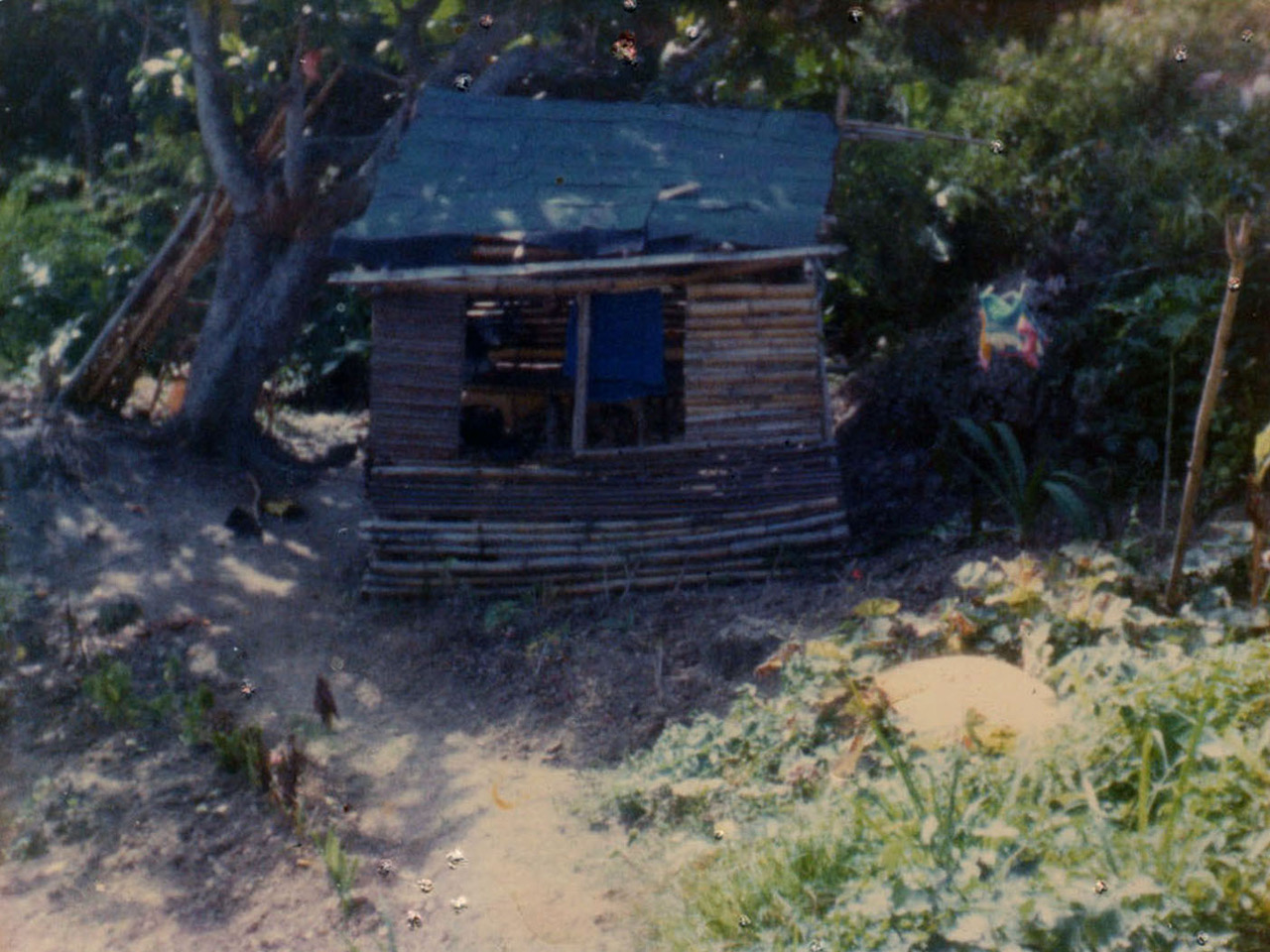
We arrived in St. Lucia by plane on Friday, 14 October 1983, for the wedding of my husband’s cousin planned for Saturday. We were going to travel in the fishing boat of my husband’s fishing partner and friend, Pert. But helicopters and planes had been flying very low over the coast, and helicopter pilots were so close they were identifiable as they surveilled our village. It was intimidating, stressful. We heard about Granada’s Prime Minister Maurice Bishop in house arrest through the girlfriend of an arms dealer-politician. Pert heard another friend had been arrested and his boat seized off St. Vincent.
My husband was born in St. Lucia and had a large family there. It was going to be a big party. We tried to find a hotel, but the hotels were cagey and said they did not allow anyone without a passport, my husband. We made camp on an insane pastel-pink sand beach with Pert and a local rasta friend fisherman. The cove water sparkled like blue diamonds. The entire cove had an aqua hue light. We were relaxing, and had a fire going, roasting flying fish and breadfruit before the wedding party that gathered after dark. Rastas, middle-class St Lucians and off-island friends like ourselves danced and drank to the two local bands until 3 in the morning. We headed back to our little jungle beach.
An hour after collapsing into sleep, I opened my eyes to a head twice the size of my husband’s next to me. I don’t drink or smoke marijuana, so I was clear-headed. I knew I had not fallen asleep next to my husband because he had been laughing loudly and gossiping, and I slept a few feet away. The head shifted, and the beak-faced sea turtle came into focus. I jumped up and tripped over the bathtub-sized shell. She had settled down next to me to lay eggs and was sort of digging with her flippers like she was swimming softly. At that moment, the rasta friend ran in from the bush, “We need to leave now!” In seconds, we grabbed essentials and flew back to the party house. We looked down on the beach from the cliffs at villagers lined up on the beach with torches and buckets for fresh cut turtle meat. The rasta friend said, “Obeah fisherman killed it.” He was crying. “They think you are wicked because it lay next to you.” He cried all the way back to the wedding party house. So did I.
People were asleep around the house. It was pre-dawn, two hours before complete daylight. We slept lightly in the yard. After drinking oatmeal with coconut milk and sea moss with raw brown sugar, we walked to the church. The church was shut. It was surrounded by various island military. My husband saw a friend from Barbados army who told him that without a permit to assemble, the wedding was shut down. There was martial law.
When we returned to the pink beach cove to gather things we had left, there was a trail of blood on the pink sand beach. An empty shell the size of a double bed was at one end of the cove. The rasta and I were so upset, my husband said, "we leave now."
October 19, 1983, a firing squad led by Deputy Prime Minister Bernard Coard, machine-gunned Prime Minister Maurice Bishop and members of the New Jewel Movement in the Fort Rupert courtyard. On 25 October, the USA invaded Granada.
Midnight in Zamorra
Rute in bridal white, trying to carry the casket. She loses it, grabs it, falls on it. She tries to embrace it, cries on it, gives up and throws herself on it. A friend tries to support her by holding her by the waist. To watch is torture; Rute is mythic in her grief. I am watching an ancient ceremony for a fallen warrior. Soccer player Diogo Jota of Porto, Portugal, husband of Rute, died in a car accident four days ago. Eleven days ago Jota married Rute, his long-term partner and mother of his three children. Devastated family, friends, colleagues, players, emotional fans in tears, coaches, politicians, and the poker-faced president of Portugal all follow Jota's body into the church. There are two funerals - another in Liverpool later.
Midnight on the B-52 highway in Zamora. Not far from my apartment in north Portugal. Jota is driving an acid-green Lamborghini Huracán to catch a ferry in Santander. He is returning to work in Liverpool. Jota’s doctor told him not to fly while he healed from a punctured lung caused by a broken rib. His brother is with him, a professional soccer player. They are travelling at night to avoid the heat. The Huracán flips across the lane barrier and bursts into flames. Jota and Andre die instantly in a forest of Iberian wolves in the Sierra de la Culebra. Rute realises they have not arrived at their destination on time. Rute identifies the bodies.
The word, fado, probably comes from the Latin word ‘fatum’ for fate, death, and utterance (uttered by the sybil?). Fado is the Portuguese national song, the soul’s wail of longing for another fate, imagined or true, a memory or something held in tremendous regard. The longing is the acute expression of the understanding of the impermanence and unpredictability of life, for more than mere survival, and might saturate an entire life or time.
An eleventh-century monk wrote in his guide-book for religious pilgrims that first-century Romans trained their armies precisely where I live, in and around Galicia. He is an exceptionally gossipy monk, and adds that the armies were deeply disturbed here. The white-haired locals, the mists and fog, rain, the winds, the cold sea, and strong currents. But mostly the women they called ‘witches’ completely freaked them out. Caesar arrived to inspect his armies and left immediately. The Romans cut a lot of rocks around here. I imagine them drinking espresso and running up and down the hills to train, jumping in the sea, and then cutting more rocks. I know. Espresso did not happen until later. But the rocks are everywhere. The witches are also everywhere and have been here longer. Galician witches are respected for their healing, wisdom, and knowledge. They belong in the territory somewhere between therapist, doctor, mother, and shaman. The land is called "Terra Meiga,” land of the witches/witch(ing) land.
Soccer players are gladiators, bleeding out their lives for the crowds, and, if fate permits, they can retire with wealth and fame, having made everyone rich in the process. Because ‘cuju’ is the Chinese ancestor of soccer, a military training exercise for warriors, the game is defined by chivalry and those associations of warrior monks, an enormous influence on the formation of the Kingdom of Portugal. Today’s game in Portugal is a socio-economic, political religion, supported by 75% of the population. ‘Cavalheirismo,’ gallantry or sportsmanship plays a role in shaping national identity, it defies gender, race, and social standing. Clubs search for young players and support and train them for years. Jota was noted to be the next Ronaldo because of his exceptional skill and gentle, chivalrous attitude.
Jota's first language was speed. The Spanish authorities have, today, released a statement saying that Jota’s Huracán skid marks indicate he was speeding. I have to ask, whether speed is the reason or not, what else would anyone do at midnight in a forest of wolves and snakes in a Lamborghini designed for speed? A Spanish friend from Asturias said he knew the road well; it was ‘incredibly dangerous.’ Spanish authorities claim the road is the most notorious in all the region. A Portuguese lorry driver who filmed the accident said, “I drive this road every day, Monday through Saturday. I know what that road is, and it's worthless. They were not speeding.” The road caused another accident a few hours earlier, before Jota and Andre’s accident.
It is necessary to move carefully in Galicia, a haunted landscape. Tossed about like a soccer ball for millennia, in the Cathedral of Santiago, you understand. The church is on fire with the wealth of new worlds, local gold mines, crusades, indulgences, donations, bribes, the tribute of conquered kings, and endless war. The Zamora road is the back door exit for retreating armies. The deserting and defeated escaped and bargained passage. How many hid and lost their way and cursed the land? My feeling is that trapped souls and witches forever spirit about the forest of wolves in the Sierra of snakes.



Comments
Natasha Hubshman (not verified)
Natasha Hubshman (not verified)
Add comment