












"Diverse" and "diversity" are words often used to describe the city of and status quo in Boston, Massachusetts; and, indeed, either as a resident in or a visitor to Boston, you can find many reasons to support these descriptions. Boston is home to an African-American governor, over fifty colleges and universities, and places of worship that range from Mosques and Temples to Baptist and Universalist Unitarian churches. Here, you can find Hotdogs, Injera and Naan breads, Kimchi, Yucca, Fungee, Apple Mash and Mooncake.
Boston; however, is and has always been quite "exceptional;" 1 since the colonial establishment of the city by dissenting immigrants in 1630, Bostonians have managed to form an identity especially distinct from that of their British foremothers and fathers, and this occurred in the presence of a pre-existing Native American population, Africans who were to follow, and industrialization that brought a massive number of emigrants from Europe. Today, Boston is likewise home to a vast medley of communities that include: Whites, African and Native Americans, the culturally Deaf, Vietnamese men and women, Kazakhs, Haitians, Jamaicans, Cameroonians, Jordanians, Puerto-Ricans, Cape Verdeans, Pakistanis, Gays, Transgenders and Transsexuals.
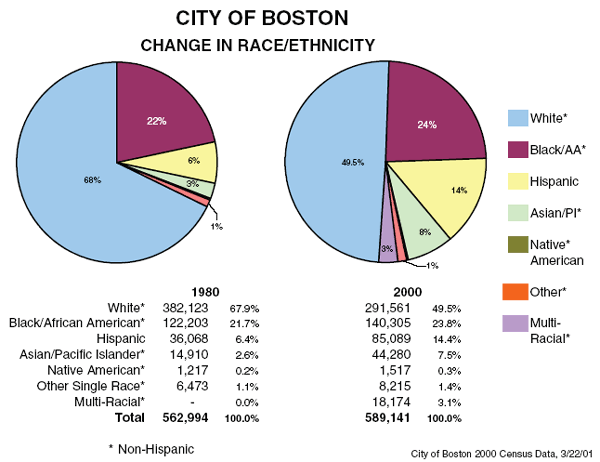
What you will rarely find in Boston though is even medium-scale social integration between any one of these groups, and this is because of an almost four hundred-year history of handling diversity via war, enslavement, religious persecution, and racial, ethnic and economic segregation. You may, for instance, note on an ethnicity graph provided by City of Boston 2000 census data that the minority population has almost doubled in the last twenty years, but in walking the streets of Boston you will not, for the most part, see a manifestation of this data. This is evidenced by dense concentrations of African Americans (and Latin Americans, Africans and those of Caribbean descent) existing and residing predominately in the neighborhoods of Roxbury and Dorchester where the White population is minimal, and where all of these minority groups are even further segregated from one another. 2 Even tourist areas such as downtown Boston (that draw a variety of populations) exhibit homogenized racial, cultural and ethnic groupings; and this is rather exceptional given that Boston is home to over half a million people comprised of Whites and Non-Whites who neatly account for 49.5 and 50% of the population, respectively.
Just as gauging the amount of opportunity and personal liberty in Boston depends upon whom you ask, so, too, is this the case with diversity. 3 Where baby boomers still outnumber their subsequent generations, race is synonymous with money, segregation prevalent, and emigration to Boston mostly dependent upon financial opportunity, those who tend to highlight and praise the "diversity" of Boston are either consciously or unconsciously segregated, of the racial or cultural majority, or representatives of the city of Boston. In her article, "Boston One of the Most Racially Diverse Cities in the Nation," Public Relations executive Erin Callanan points out that "1 in 4 Boston residents is foreign born" and that "more than 200 languages [are] spoken [in Boston]." Non-minority McKenzie Lawton tells us in her blog "Why I'm a Bostonian" that although "[racial] [d]iversity isn't first in mind when you think of Beantown [...it is] much more diverse than people think," and it is so, according to Lawton, because of "different areas of the city to venture to" and "visitors from all over." Unintentional experimenters of more vigorous integration; however, such as those who are party to interracial relationships and friendships, or those who have visited certain areas of Roxbury or Dorchester and, for example, an Irish pub as non-minorities and minorities, respectively, have, from my first and second-hand experiences, mostly met with discomfiting results. Moreover, compare the statements of Callanan and Lawton with those of six minority graduate students (of varying races and ethnicities) in the Division of Medical Science at Harvard University in Cambridge; excepting one, all comment upon either the lack of diversity in their programs or in Boston or both. Says Michelle R. Johnson Hamlet: "Even though Boston is a culturally diverse city it is not well integrated [...]" (DMS). 4 Indeed, Boston may be diverse as far as languages spoken and things to do and people to see, but it is homogeneous in practicality, demonstrating a form of segregated diversity that should make us think twice about our standard usages of "diverse" and "diversity."
Of course, there is a very fine and blurry line between pride in and comfort with one's own race, ethnicity and culture and perceived social isolation, but there exists no sensible connection between diversity and segregation. Diverse and diversity mean not only presentation of variety, but also acceptance of that variety; they indicate not only a certain level of integration, but also a certain level of accepted integration that, after the opportunity of nearly four hundred years of practice, Boston both should and could reflect more of currently.
As I was born in Boston (and raised in Roxbury), this is not meant to be an indictment of Boston, nor is it meant to imply that intolerance in any form does not exist everywhere, but it is meant to encourage the expansion of our current notions of diverse and diversity, and to highlight the disastrous results of America's past history of handling diversity as a problem rather than as a very real and irrevocable reality.
Notes:
1 The term "American exceptionalism" was coined by Alexis de Tocqueville in his Democracy in America (1835), a compilation of his observations of American government.2 Areas and "sub" neighborhoods within Roxbury include: Dudley, Jackson and Eggleston Square, Warren Gardens, Academy Homes, Seaver Street, The Point, Lennox, Melnea Cass, Martin Luther King Boulevard and Warren Avenue; and, within Dorchester: Mattapan, Codman Square, Four Corners, Uphams Corner, Fields Corner, Norfolk, Franklin Field, Columbia Road, Blue Hill Avenue, American Legion Highway and Grove Hall.
3 See "Rags to Rags, Riches to Riches" by Clive Crook and "Sweet Land of...Conformity? (Americans Aren't the Rugged Individuals We Think We Are)" by Claude Fischer.
4 DMS / Diversity /Recent Graduates. Division of Medical Sciences: Harvard University, 2008. See http://www.hms.harvard.edu/dms/diversity/meetgrad.html.

Kindra J. Ferriabough received her BS in English Literature at Northeastern University's College of Professional Studies. She loves to laugh and engage in philosophical debates that inevitably lead nowhere. Her fiction has previously appeared in Zygote in My Coffee and is forthcoming in Ken*Again, Battered Suitcase, and Clockwise Cat. She is currently at work on an essay that explores the relevance of Marxist literary theory in African American literature.
[an error occurred while processing this directive]