













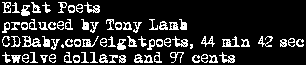
The poems on this CD have a unifying thread of music as the weave upon which they hang, something –
"like Aeolian harps in the weed-tangled air." –
As put by Bill Mycock in his first outing on track two. This poem about his father's boots - entitled appropriately enough, "His Boots" - weights an earthy metaphor of decaying time to a narrative of recalling his childhood and male parent's life as a farmer. This piece is second up on the CD; after the entrance of Zeeba Anasari's floaty water poem, "Sunrise", which is the track one counterpoint to her track nine piece, "David Restored." In this poem she addresses Michelangelo's statue:
"…feasting….the stars…. measure minded….perfect thigh…a model of….myth locked by gravity into history…leopard spots at old bite….. circles….running full tilt at stone…oils his body…feeds back youth"
Here Ansari deploys a rock register rather than water metaphors; leaving us in no doubt that her voice has a rich depth and maturing sense of how to successfully wield abstract and concrete in the one sling-shot, splattering her inner voice on the canvas page to create a weighty, close to disembodied address from her muse. A technique Eliot was a master of, and which Yeats describes as "cold and passionate as the dawn."
In track three Victoria Field's well-modulated middle England tones sashay in, painting an erotic mental space with the aid of a fully sexed up metaphor of musical lust. Kicking off in a slinky - almost kinky – register; from an aural platform where the narrator is recalling her previous night's wet dream, she offers us her main fantasy stud bunny, the Russian concert god, Sergei Kuriokhinby. He is the hard-core artist performing a full on all night service, fulfilling her double wish of getting deep down, dirty and jiggy with it in Liverpool and St Petersburg. These two cities, coupled with one lover from the unconscious realm, score bulls eye in the target of her willingness to fully surrender in a near "ooh arrrghh" state of wild animal passion; culminating with Sergei -
"plucking me senseless", ejaculates the poet; aiming her pitch to oscillate within various vectors, the full nuances of which would need a larger treatment than this to expound, but which is nevertheless worth a listen. And although it would be easy for the critic to yield good clean satire from the uniquely British, seaside postcard saucy-like performance, its mean buoyancy level is above halfway and so the work floats in the ear of the mind, balanced by an impressive command of appropriate rhyme deployment, which makes for a piece going "all the way."
Her second deposit "Petition" is a poem about Cornish Saints:
"sleeping…..without armies….soft and strong……as white as bone…….The world ….a squat …..surf…bracken….private torn…damp with moss…prayers and tears….gentleness….Seek out the wells…miracles trickling with the rain."
This stays a respectable distance above the lifting zone of competent poetry, and within Lamb's swirling trippy-led string accompaniment the soothing piece is as far removed from sex as Lands end is from John O'Groats, and so in her two pieces we are gifted an insight into two extremities of her poetic spectrum.
Field is positioned before Paul Newman's number four offering - "Titanic", which is delivered in a slightly declamatory register, and where:
"…deeps deeps…not a bone speaks….Fittings….trinkets…held in disasters amber….sifting….foredoomed… history's shrapnel"
His second effort is in similar vein.:
"you nod…go into a trance…cough…. regurgitating…pearl….cradled in froth…a dazzling….vomiting up …dawn…plucked….calm as ice….throbbing….angry….We must endure….wipe clean like slate of the day….an opening….through to this world…quench you desperate soul…richer than the grief…it is all….you are likely to get."
And whilst this poetry is not as much in a life affirming mode as many of the others on the CD, its effort in attempting to strike the balanced note using images from the darker half of our inner soundscape shows he is unafraid to mine the depths for an interesting poetic yield.
Liz Rowetts "Green and Drowning" is a water poem in the same ballpark of poesie as Ansari's, but her voice rings deeper, as though the poet is more firmly in contact with her Muse's rhythm.
"…curious within the green mysterious….sifting and singing….the gods of tide….green feathers …tearless eyes….a thin trace of bubbles."
Her pacing and unrushed delivery indicates a poet who is comfortable to let her words take their time to do the work, and which reflects a long and well-learned apprenticeship in the poem game.
"Looking for Money on Ground" by Loic Rich is a well mannered youthful sounding voice offering:
"…dark …slender…travel…between….the crisp tenner…money…hunting, driven by hunger, drives away our reason….sleeping by the…ancient…city walls…no search party calls."
This short one languish bob of a language artefact strives for lift off within Tony Lamb's various string and wind instrument backing. His voice is less engaged with its true source than Rowatts, and beneath his register a hint of isolation is evident, which is perfectly understandable. I would imagine that the poetry scene in St Ives is overshadowed by the main stay of visual artists who flock to the world famous centres of painting in that town. And I also imagine that to self confirm as a poet in such a place would be more difficult than somewhere like Dublin or an English centred Oxbridge college, but as a young man he has plenty of time for his voice to mature and fully connect with its essential rhythm.
Lamb successfully aligns his music to complement, what I imagine, is his aural interpretation of each poet's delivery; be it the retro Tellytubby innocence his horn warbles to conjure up a suburban Mister men'ish sound (famous UK cartoon) for Pam Smith- Rawnsley's "Hedges" - casting a glance to the time when
"shaggy green bears as wide as houses…safe as houses inside if you braved the gloom… the scolding screech of despair…the fortress of leaves"
or - the savvy ethnic-cosmopolitan strings framing the performed text of this offerings true master, Derek Hines, who recites from his tour de force re-rendering of the ancient Sumerian myth "Gilgamesh."
I was lucky to have been very kindly given Hines' book by Tony Lamb, after I contacted him asking for texts to the poems on the CD, which he also sent on photocopied sheets of A4. I had big ideas of doing a full critical treatment of music, text and delivery, but quickly recognised (once I had all the material to hand) that this was a major undertaking, particularly if the critic, once he had received the texts, then promptly lost them during his weekly warble workshop with fellow language artists, like I did. And although I am unknowing what blather to spiel on this subject of this idiotic loss, my defence is one of honesty; as the poetic return or yielding by-product of my buffoonery has been an introduction to Hines's work, which is the first long poem I have read, recognised as such, and which kept my eyes zipped to the page from first to last.
His appearance alone makes the ownership of this CD worthwhile. Anyone professing a poetic interest who has not come across his award winning book should, in my opinion, acquaint themselves with his work and experience a truly original contemporary Canadian voice of great power and breadth, and which most readers, I contend, would recognise as operating on the higher frequencies of poetic resonance. One which shows deep awareness and accomplishment of both craft and technique. Terms roughly translated through a Heaneyesque filter of good poetic practice to mean, the construction or "making" of quality verse by a poet working with their "innate gift"; a gift which Hines has in obvious abundance.
Hines's two poems are stationed dead centre and final in the play list, giving weight to the notion that he is the crucial poet of this collection, much like Heaney is within the an Irish poetic flux. Here is a snaffle of the text:
"Fill the sky to choking with a reedbed…a blind of shafts….the very air…woven by his merest gesture to fable……the crush of gravity's paint…till void reabsorbs…..a smash and grab of years…..a protector …got drunk, stayed drunk…back flip….the map…marking time….washed up as far south as man or god can go…..like the madam who ran the roadhouse….our lady of times edge….we find him there…pushed to the worlds prow, barely more than a beat in the days narrative"
And whilst he is definitely the star of this collection, this is not to say that the others are just filler padding him either side, far from it. Hines is the equivalent of a Mossbawn bard or John Montague, and one of the most vital voices I have ever heard, and his appearance here is a snippet from a long poem, whilst the others are stand-alone occasional poems. The benefit for my own practice has been pivotal, as well as a good listen.

Desmond Swords writes for irishpoetry.blogspot.com.